My Bank Holiday started last Thursday with my usual trip to the Chelsea Flower Show. My plan was to catch the 7.02 train from Stevenage, change at Finsbury Park and get to the gates around 8am. However, I arrived a bit early and got on to the 6.45 Kings Cross express-and there were plenty of empty seats!!. Arriving at Kings Cross was a bit disorientating as I haven't been there since the redevelopment had begun some years ago, so I got off the train, expecting to go into the foyer and down the steps, only to discover that it had all disappeared. Now, you leave the station, cross a plaza and try and decide which of two underground entrances is the right one. Get it right and you arrive at the Victoria line entrance.
I reached the Chelsea gates at 7.35 to find a bit of a queue waiting for the gates to open. A small group were let through to the entrance, and a little while later I moved forward but still had to wait 15 minutes for the official opening. When we were let in, almost everyone headed for the main gardens, so I did the usual thing and headed for the artisan gardens-which I had to myself for the first twenty minutes. Perfect, as it they are really hard to view later in the day when th crowds build up. The one drawback is that most of the gardens were still setting up for the day and most didn't have any literature to pick up.
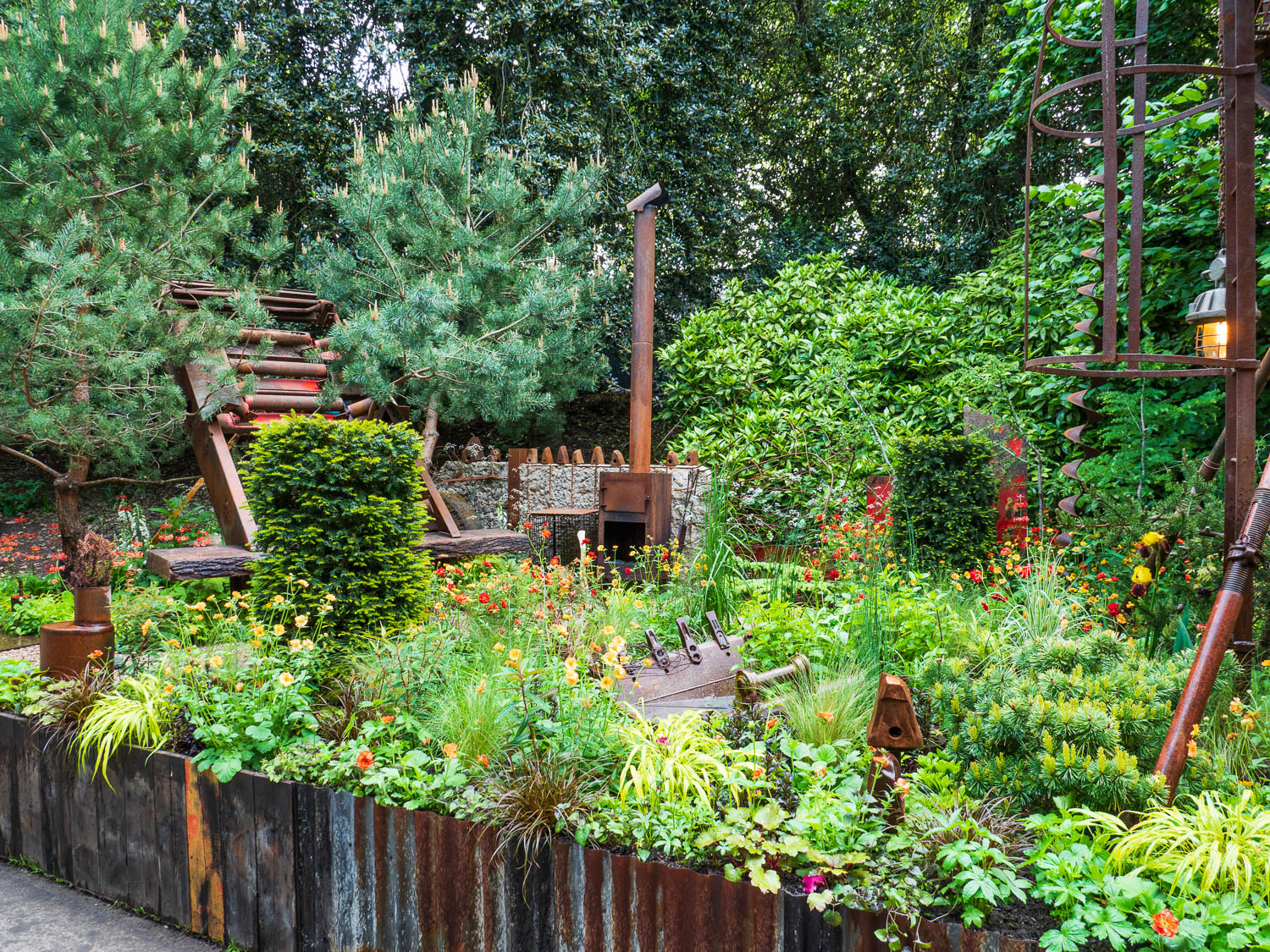
The key feature for all of the gardens, which has been developing over the last few years is a more naturalistic wildlife friendly planting style, while still incorporating interesting (and sometimes unusual) design features.
Mr Ishihara was here as usual with his Japanese garden full of maples, moss, rocks and pines, plus a small studio and a shower-well why not. I felt it wasn't up to some of his previous efforts, but it got gold, and was worth studying closely with lots of nice, interesting planting details.
The High Maintenance garden was very nice, a workshop/garage with an old Morgan had been left largely neglected for some time and had run somewhat wild.
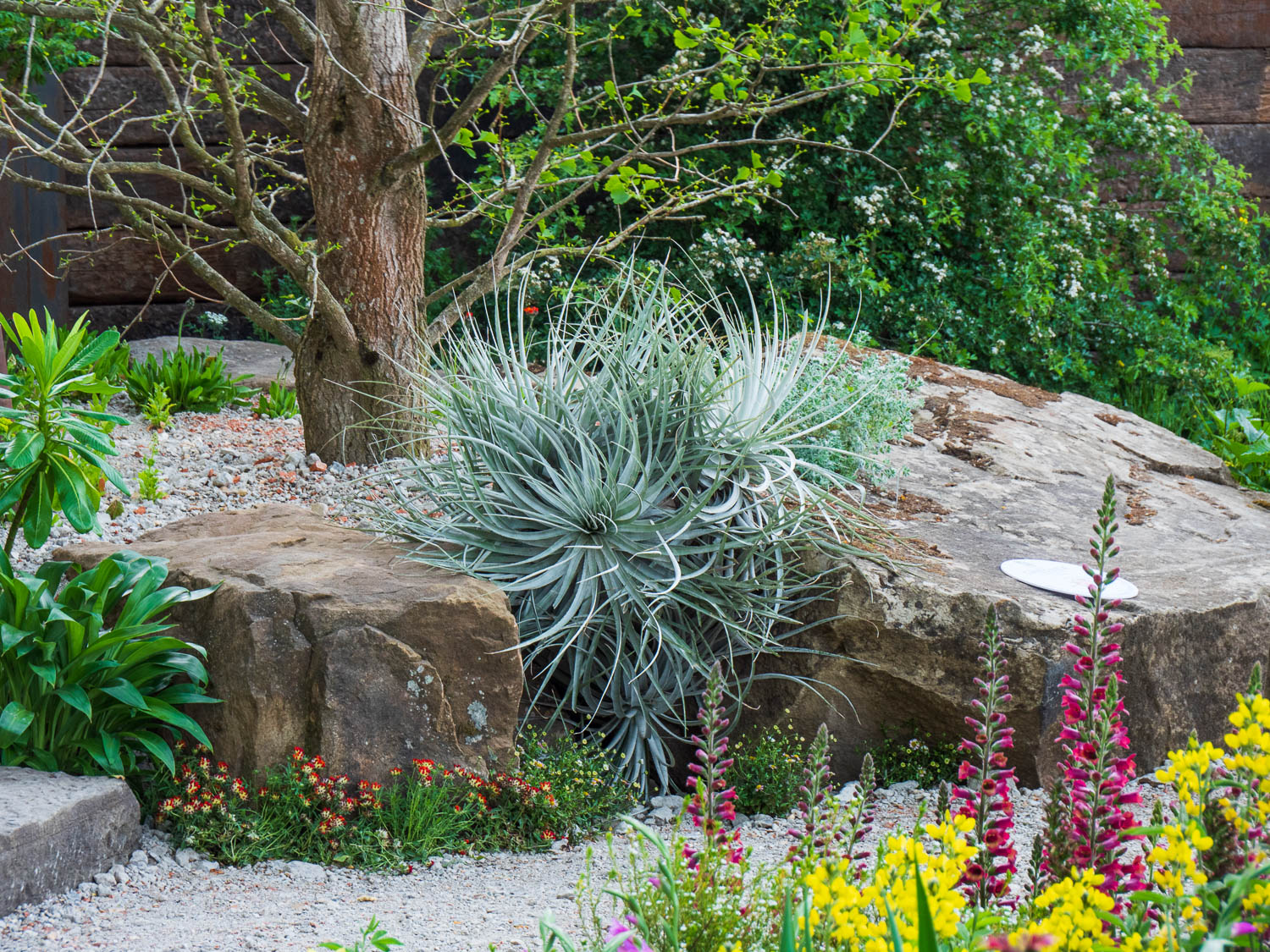
Leaving the Artisan gardens I arrived at Main Avenue and hit some barriers. Apparently, because Kate Middleton had been involved in one of the gardens, everyone wanted to see it, and walk through it so there was a queueing system-and even at 8.30 am it was a big one. Needless to say I avoided that one. Unfortunately, with the BBC filming some of the other gardens at the south end were inaccessible so I started with the Chilean garden as this was one I really wanted to see, having an interest in the flora of South America (unfortunately some are rather challenging to grow for me). Fortunately the bromeliad Fasicularia bicolour below is one I can, and I now have many rosettes, though they haven't flowered for a couple of years.
The rest of the gardens in Main Avenue were a mixed bag, lots of umbellifers, foxgloves and irises, and lots of green foliage.
I did like Sarah Eberle's grain silo and xerophytic planting, in the Resilience garden, and Andy Sturgeon's M&G garden with it's backdrop of burnt sculpted oak. Both repaid close study as the planting in both, while very different was very interesting. In particular, the M&G garden was criticised for being 'green' but there were lots of colour spots from orchids, primulas, irises and aquilegias, while the greenery was very varied in structure and tone.
Up on the northern section, the smaller gardens had a lot of good features but it was the sculpture in the Royal Hospital that really attracted attention. Featuring a D-Day veteran in Portland Stone looking back at his younger self, semi-transparent, made from what appeared to be washers and with a background of Thrift and beach defences.
Two hours was spent in the marquee looking at the various nursery and horticultural stands. Unfortunately I had a camera problem as the batteries died in quick succession. I suspect (hope) that one of them had been sitting in my pocket for some time and had lost a considerable charge, and I had presumably just been using two in rotation. So few photos for the rest of the day, though I took a few with the phone.
It didn't seem so crowded this year, so it was possible to spend a lot of time on individual stands, maybe have a quick chat with some of them and just generally admire the very high quality of the plants. Kelnan's rests and South African plants was attractive, as were the bromeliads and air plants on one of the stands. Orchids and bonsai featured on several stands, and there were the usual stands from Kirstenbosch and Grenada. Alpines were in short supply this year with only a small display of planters from one nursery. The usual Hosta people were there, though I didn't find any that I wanted-last year there were several red stemmed varieties that looked quite nice, but non were available. The same with some of the others, Heuceheras, Astrantias, Irises and Bulbs, lots of nice plants but non were standouts.
I was, therefor, for once rather restrained in my purchases, despite taking more money than ever before, and returned with just three plants. Another orchid, Cypridium regina, a new perennial foxglove, Digitalis Firebird, and a small succulent, a very spiky euphorbia.
After leaving the marquee, I had a bit of lunch and then spent a couple of hours just wandering around. Some of the gardens do change their appearance somewhat as the day progresses, and the lighting changes, but of course there are a lot more people around so it can be very hard at times.
Eventually I had to leave, having walked some 6.5 miles in the process. I left via the now crowded Artisan Gardens and found Mr Ishihara sitting behind the crowd so I took a quick snap with the phone. I wasn't the only one.
Monday, 27 May 2019
Thursday, 16 May 2019
Saturday's Photos
I've been through the photos from Saturday, most of which were only fit for the bin. The big problem seemed to be a combination of wind, heat haze and distance, never a good combination.
I didn't even bother to try to image the Dotterel as I knew it wouldn't work, as the results would have ended up like a very bad pointillist/impressionist painting-lots of coloured spots.
Titchwell was a bit better though and the very vocal Sedge Warbler in a bush by the path attracted a lot of attention.
Also in the same area by the hide was the Wall Brown.
I tried to get some of the Marsh Harriers flying overhead while waiting for the Great Reed Warbler, but the results were horribly backlit and I couldn't salvage anything from the images.
At Burnham Overy I was expecting to get a few decent images of the Spoonbill, but the heat haze degraded what I obtained somewhat. However they were a damn sight better than the ones from Amwell last weekend.
I didn't even bother to try to image the Dotterel as I knew it wouldn't work, as the results would have ended up like a very bad pointillist/impressionist painting-lots of coloured spots.
Titchwell was a bit better though and the very vocal Sedge Warbler in a bush by the path attracted a lot of attention.
Also in the same area by the hide was the Wall Brown.
I tried to get some of the Marsh Harriers flying overhead while waiting for the Great Reed Warbler, but the results were horribly backlit and I couldn't salvage anything from the images.
At Burnham Overy I was expecting to get a few decent images of the Spoonbill, but the heat haze degraded what I obtained somewhat. However they were a damn sight better than the ones from Amwell last weekend.
Wednesday, 15 May 2019
Catching Up On The Weekend
Ive been a bit tardy with the writing this week, and I haven't even got round to getting the photos off the camera yet, so they will have to follow later.
On Saturday I took Mum over to see Sarah and Ed as it was the day of the Barkway Fair. The forecast was a bit indifferent and we had quite a bit of it over the course of the day. I drove up in torrential rain, which had pretty much finished well before we reached Royston and it wasn't too bad by the time we arrived. I had a quick look round the garden with Sarah, unloaded the car which basically meant handing over lots of plants (which she reciprocated later) and then took her to the fair, leaving Mum and Ed to have a rest.
The fair is basically an excuse for Sarah and I to do a bit of plant hunting for the garden as there are usually a few stall there, but this year we were rather restrained and I only ended up with a few replacements for things that I have lost over recent winters. The local Mayfly Cider company was there (highly recommended) so naturally I bought some, and a nice bonus was the Bancaster Brewery stall with a large selection of beers from Norfolk, which looked very tempting so four bottles came home with me.
As mentioned earlier we had a lot of weather. While it was (briefly) sunny and warm when we got there, short showers then arrived which made the drive out of the field a bit interesting-and we were one of the early leavers. I suspect it got very muddy and slippery in the afternoon. Heavy hail showers later couldn't have helped. However in between there were brighter spells. Sarah has had regular Holly Blues and I saw my first of the year that afternoon, plus she appears to have a resident Blackcap in the garden, while the local Swallows seem to be back in force.
Sunday was a lot better regarding weather, and Colin and I spent the day on the Norfolk coast. I was sunny all day, though there was a bit of a cool north easterly.
We stopped first at Chosely to have a look at the Dotterel in the field south of the barns. Numbers had been building over the previous couple of days with up to 27 on Sunday. However, I went through the flock several times and each count came to 21. Not sure if Ive ever seen so many in one place before. Nearby a singing Corn Bunting and the first of many Lesser Whitethroats was a nice accompaniment.
Titchwell was rather busy as a Great Reed Warbler had been found earlier in the morning. I was hoping it would be good here, and while I managed 78 species in 2-3 hours there was lot we missed. The real problem was the lack of waders. Plenty of Avocets of course, and the saline lagoon behind the beach had the usual gathering of Grey Plover, Turnstone and Oystercatcher, but that was about it. A handful of Dunlin and Black Tailed Godwits, singles of Redshank, Curlew and Lapwing (!), but where were the Ruff, Spotted Redshanks, Knot etc that I was expecting? Apparently small numbers have been going through early in the morning and not staying.
I remember when Mediterranean Gull was a bit special here, and something of a highlight, so the 150+ now nesting feels a bit strange. Rather like Little Egret and Red Kite here in Herts I suppose.
Nice to see a female Bearded Tit with young, with many others pinging away in the reeds, and having failed to go out during last years hot summer, my first Sandwich and Little Terns in two years. I went through them, and the gulls hoping for Arctic Tern and Little Gull (singles were apparently there) but I couldn't find them. I did find a wall Brown, so my butterfly list was improving.
Naturally we had to go for the Great Reed so made our way through the Fen Trail, picking up our first Azure Damselfly. The warbler proved to be very elusive and kept low in the scrub so most of the assembled crowd never saw it. There were a few brief snatches of song and the odd call now and again. Eventually a few photos surfaced, but it was a rather disappointing bird-they are usually loud and showy. Unfortunately, with it being by the Turtle Dove feeding station we never saw the doves either as they were generally staying away while the crowd was present.
In the afternoon we went to Burnham Overy. As it turned out, the Purple Heron that had been around for three weeks seemed to have departed, and a feeding Spoonbill was all we could find (not too hard as the breeding colony isn't all that far from here). More wall Browns, a Green Hairstreak, lots of Orange Tips and a Large Red Damselfly meant i wasn't a wasted walk.
We called in at Weeting on the way home. Luckily it didn't take long for one of the nesting Stone Curlew to appear. This year the East Hide is favoured, but it sounds like there are only a couple of pairs this year, and this nest is the only one on view. We were concerned by the hight of the turf, and the many pine seedlings and it appears that the rabbit population has been decimated, which may prove problematic later in the year as the vegetation grows. Lots of Brimstones here, and a pair of Small Coppers was handy-I didn't see many last year, and none in spring.
On Saturday I took Mum over to see Sarah and Ed as it was the day of the Barkway Fair. The forecast was a bit indifferent and we had quite a bit of it over the course of the day. I drove up in torrential rain, which had pretty much finished well before we reached Royston and it wasn't too bad by the time we arrived. I had a quick look round the garden with Sarah, unloaded the car which basically meant handing over lots of plants (which she reciprocated later) and then took her to the fair, leaving Mum and Ed to have a rest.
The fair is basically an excuse for Sarah and I to do a bit of plant hunting for the garden as there are usually a few stall there, but this year we were rather restrained and I only ended up with a few replacements for things that I have lost over recent winters. The local Mayfly Cider company was there (highly recommended) so naturally I bought some, and a nice bonus was the Bancaster Brewery stall with a large selection of beers from Norfolk, which looked very tempting so four bottles came home with me.
As mentioned earlier we had a lot of weather. While it was (briefly) sunny and warm when we got there, short showers then arrived which made the drive out of the field a bit interesting-and we were one of the early leavers. I suspect it got very muddy and slippery in the afternoon. Heavy hail showers later couldn't have helped. However in between there were brighter spells. Sarah has had regular Holly Blues and I saw my first of the year that afternoon, plus she appears to have a resident Blackcap in the garden, while the local Swallows seem to be back in force.
Sunday was a lot better regarding weather, and Colin and I spent the day on the Norfolk coast. I was sunny all day, though there was a bit of a cool north easterly.
We stopped first at Chosely to have a look at the Dotterel in the field south of the barns. Numbers had been building over the previous couple of days with up to 27 on Sunday. However, I went through the flock several times and each count came to 21. Not sure if Ive ever seen so many in one place before. Nearby a singing Corn Bunting and the first of many Lesser Whitethroats was a nice accompaniment.
Titchwell was rather busy as a Great Reed Warbler had been found earlier in the morning. I was hoping it would be good here, and while I managed 78 species in 2-3 hours there was lot we missed. The real problem was the lack of waders. Plenty of Avocets of course, and the saline lagoon behind the beach had the usual gathering of Grey Plover, Turnstone and Oystercatcher, but that was about it. A handful of Dunlin and Black Tailed Godwits, singles of Redshank, Curlew and Lapwing (!), but where were the Ruff, Spotted Redshanks, Knot etc that I was expecting? Apparently small numbers have been going through early in the morning and not staying.
I remember when Mediterranean Gull was a bit special here, and something of a highlight, so the 150+ now nesting feels a bit strange. Rather like Little Egret and Red Kite here in Herts I suppose.
Nice to see a female Bearded Tit with young, with many others pinging away in the reeds, and having failed to go out during last years hot summer, my first Sandwich and Little Terns in two years. I went through them, and the gulls hoping for Arctic Tern and Little Gull (singles were apparently there) but I couldn't find them. I did find a wall Brown, so my butterfly list was improving.
Naturally we had to go for the Great Reed so made our way through the Fen Trail, picking up our first Azure Damselfly. The warbler proved to be very elusive and kept low in the scrub so most of the assembled crowd never saw it. There were a few brief snatches of song and the odd call now and again. Eventually a few photos surfaced, but it was a rather disappointing bird-they are usually loud and showy. Unfortunately, with it being by the Turtle Dove feeding station we never saw the doves either as they were generally staying away while the crowd was present.
In the afternoon we went to Burnham Overy. As it turned out, the Purple Heron that had been around for three weeks seemed to have departed, and a feeding Spoonbill was all we could find (not too hard as the breeding colony isn't all that far from here). More wall Browns, a Green Hairstreak, lots of Orange Tips and a Large Red Damselfly meant i wasn't a wasted walk.
We called in at Weeting on the way home. Luckily it didn't take long for one of the nesting Stone Curlew to appear. This year the East Hide is favoured, but it sounds like there are only a couple of pairs this year, and this nest is the only one on view. We were concerned by the hight of the turf, and the many pine seedlings and it appears that the rabbit population has been decimated, which may prove problematic later in the year as the vegetation grows. Lots of Brimstones here, and a pair of Small Coppers was handy-I didn't see many last year, and none in spring.
Saturday, 4 May 2019
Spoonbill at Amwell
Just my luck. Back at work at the beginning of the week and I find that a Spoonbill has been performing well-shame it hadn't been present on Sunday as they are not all that common in Herts and they don't stick around. I've not seen one in the county in over30 years.
This one has done and being in full breeding plumage there have been some amazing images posted on social media etc over the last few days, so pretty much everyone in the county has been down to see it.
I would have gone after work yesterday but other things cropped up and I wasn't able to go. This morning I did the usual shopping run with Mum and went down despite the lack of news, arriving at 1015.
I met Bill as he was leaving to be told that three Arctic terns had been present early on and that the Spoonbill was sitting in the heronry and not easy to see. I was able to see a suitable large white shape in the trees and walked down the path to enable me to look back up the pit from the south east. It still wasn't easy as it seemed to be spending a lot of time hunched up but every now and again it raised its head showing the crest quite well.
There were a lot of hirundines again with large numbers of House Martins, some Swallows and a few Sand Martins. In the strong cold winds it was hard work going through the Common Terns and I wasn't able to pick anything unusual out of the 10-15 present.
In view of the unpleasant conditions, I made my way to White Hide where it was nice and sheltered. Looking down the pit I found at least 15 Swifts in the distance, my first of the year. The pair of Little Ringed Plovers were, as usual on the small island in front of the hide.
Two pairs of Teal were still around, and there were a few Herons and Little Egrets around, though there were also a lot sitting on nests on the island. One of the Oystercatchers was also around. I didn't see any butterflies or dragonflies-it was far too cold and windy, and there wasn't any point going on to Hollycross.
Back home, my hybrid Cypridium orchid 'Parville' was looking quite nice with several flowers, so i took a few snaps before the afternoon hail storms arrived.
This one has done and being in full breeding plumage there have been some amazing images posted on social media etc over the last few days, so pretty much everyone in the county has been down to see it.
I would have gone after work yesterday but other things cropped up and I wasn't able to go. This morning I did the usual shopping run with Mum and went down despite the lack of news, arriving at 1015.
I met Bill as he was leaving to be told that three Arctic terns had been present early on and that the Spoonbill was sitting in the heronry and not easy to see. I was able to see a suitable large white shape in the trees and walked down the path to enable me to look back up the pit from the south east. It still wasn't easy as it seemed to be spending a lot of time hunched up but every now and again it raised its head showing the crest quite well.
There were a lot of hirundines again with large numbers of House Martins, some Swallows and a few Sand Martins. In the strong cold winds it was hard work going through the Common Terns and I wasn't able to pick anything unusual out of the 10-15 present.
In view of the unpleasant conditions, I made my way to White Hide where it was nice and sheltered. Looking down the pit I found at least 15 Swifts in the distance, my first of the year. The pair of Little Ringed Plovers were, as usual on the small island in front of the hide.
Two pairs of Teal were still around, and there were a few Herons and Little Egrets around, though there were also a lot sitting on nests on the island. One of the Oystercatchers was also around. I didn't see any butterflies or dragonflies-it was far too cold and windy, and there wasn't any point going on to Hollycross.
Back home, my hybrid Cypridium orchid 'Parville' was looking quite nice with several flowers, so i took a few snaps before the afternoon hail storms arrived.
Tuesday, 30 April 2019
Amwell on Sunday
The storm promised over the weekend turned out to be a bit of an anti climax around here. While we had a very windy Saturday, there was very little rain, which the garden desperately needs. It was a bit quieter on Sunday, though rather chilly with a cool north westerly.
I decided to go to Amwell for a few hours. Unfortunately the main road, the A602 was shut for resurfacing so everyone had to go through Watton at Stone and it was a rather slow journey, and I arrived later than usual. The Sunday crowd had just started their walkabout leaving Phil and Murray at the view point. Though the wind was against it, I had hoped that some overnight showers had brought a few birds in, but that hadn't happened.
There were a lot of hirundines at times though, with birds feeding at the south end of the lake and occasionally moving through. Often they would vanish and then all of a sudden a flock would appear overhead. Most were Swallows, with decent numbers of House Martins as well-last year was dreadful and I only saw a handful all year, so it was good to see so many.
There were a few waders around, a pair of Little Ringed Plovers lingered for an hour or so, they have been present on and off for a while now. Eventually a Common Sandpiper was found, and the Oystercatcher pair were also present. Two pairs of Teal were hanging on, plus a few Shoveller and there were around 10-12 Common Terns.
One Cuckoo was calling from the usual trees beside the White hide before being driven off south by a Magpie. Later it or another was heard more distantly. I assumed it was at Hollycross but it seems to be have been further up the Ash valley. I did eventually head over to Hollycross as it had just opened but it was far too cold for any dragonflies. There were a lot ofSedge and Reed Warblers singing, and several Whitethroats were also around. On my way back, I thought that I heard the Grasshopper Warbler briefly. It seemed to be in the same area as last week, though maybe further back into the reed bed.
Back at the view point Barnet Dave was the only one around and he had sensibly donned gloves-I was certainly feeling the cold. A quick scan failed to provide much that I hadn't seen earlier.
Getting home wasn't fun. I got caught up in the car boot queue which was at a complete standstill. Turning round I got into Ware which was also full of slow moving cars. Turned out that the south bound A10 was shut so everyone was trying to divert through the town, so as I didn't want to chance Watton at Stone I had to head north and come home through High End and Whempstead. A 13 mile journey took 45 minutes.
I decided to go to Amwell for a few hours. Unfortunately the main road, the A602 was shut for resurfacing so everyone had to go through Watton at Stone and it was a rather slow journey, and I arrived later than usual. The Sunday crowd had just started their walkabout leaving Phil and Murray at the view point. Though the wind was against it, I had hoped that some overnight showers had brought a few birds in, but that hadn't happened.
There were a lot of hirundines at times though, with birds feeding at the south end of the lake and occasionally moving through. Often they would vanish and then all of a sudden a flock would appear overhead. Most were Swallows, with decent numbers of House Martins as well-last year was dreadful and I only saw a handful all year, so it was good to see so many.
There were a few waders around, a pair of Little Ringed Plovers lingered for an hour or so, they have been present on and off for a while now. Eventually a Common Sandpiper was found, and the Oystercatcher pair were also present. Two pairs of Teal were hanging on, plus a few Shoveller and there were around 10-12 Common Terns.
One Cuckoo was calling from the usual trees beside the White hide before being driven off south by a Magpie. Later it or another was heard more distantly. I assumed it was at Hollycross but it seems to be have been further up the Ash valley. I did eventually head over to Hollycross as it had just opened but it was far too cold for any dragonflies. There were a lot ofSedge and Reed Warblers singing, and several Whitethroats were also around. On my way back, I thought that I heard the Grasshopper Warbler briefly. It seemed to be in the same area as last week, though maybe further back into the reed bed.
Back at the view point Barnet Dave was the only one around and he had sensibly donned gloves-I was certainly feeling the cold. A quick scan failed to provide much that I hadn't seen earlier.
Getting home wasn't fun. I got caught up in the car boot queue which was at a complete standstill. Turning round I got into Ware which was also full of slow moving cars. Turned out that the south bound A10 was shut so everyone was trying to divert through the town, so as I didn't want to chance Watton at Stone I had to head north and come home through High End and Whempstead. A 13 mile journey took 45 minutes.
Tuesday, 23 April 2019
Easter Break
We have just had a wonderful four days off work and I have been out and about for three of them.
Colin and I decided a long time ago that trying to do any long distance birding, or visiting coastal sites is never a good idea on Bank Holidays (as is venturing anywhere near the M25) unless there is something really worth going for, so we tend to stay local.
On Saturday we went out for the more or less traditional April Little Paxton and fens trip with as view to getting a few of the usual year ticks. This of course meant a fairly late departure. It was a bit worrying leaving Stevenage in fairly dense fog, but it cleared as we headed up the A1 and by the time we reached the Paxton car park we had lots of sunshine and blue skies. It was still a bit chilly though, with a bit of an easterly breeze.
I was surprised to see how low the water was in the Heron Lake, several feet lower than normal. Whether this was deliberate with a view to producing expanses of mud and islands for passage waders and breeding birds, or whether it was down to the lack of rainfall over the last year or so, I don't know. Over the course of the two hour circuit we managed to pick up all of the visiting warblers, apart from lesser Whitethroat, and, unfortunately only a single Nightingale, which does seem to be dealing here.
There were about a dozen Common Terns with a single Black Tern among them. Always distant, I couldn't get a decent image of it. There were, or had been, a couple of Little Gulls but one or two possible candidates turned out to be false alarms. Heard our first Cuckoo (possibly two present) and I had a flyover Yellow Wagtail. No hirundines at all.
Plenty of Orange Tips, Peacocks, Speckled Wood and Green Veined Whites.
We then went to Berry fen near Bluntisham where a Green Winged Teal had been present for a long time. It had warmed up considerably and it was quite nice walking along the Ouse bank to get to the fen, one of a series managed by the RSPB as part of the Ouse Fen project.
It proved to be a wasted exercise in that we failed to find the Teal, though there were many common Teals present, but trying to sort out distant sleeping ducks in the vegetation is never easy.
We finished the day with an afternoon at the Ouse Washes, and by now it had got even warmer and it was an exhausting trudge up to the hides. This was the only place with any hirundines-a few Swallows feeding over and around the pumping station. For once there were many Tree Sparrows feeding around the car park and picnic area.
We had hoped to pick up Garganey and Cranes here, but of course we failed again. There were still a lot of Wigeon, Teal and Pintail remaining from winter, along with several flocks of (presumed) breeding Black Tailed Godwits and Avocets but Ruff were absent. I was half expecting a Great White Egret as well but could only find Little, and there should have been one or two harriers as well.
Sunday morning I paid a visit to Amwell. The area in front of the view point is looking pretty good for a passing wader though there haven't been many as of yet. Two Little Ringed Plovers had been present first thing but had departed. Lots of Sedge Warblers in the reeds and as usual the thick bramble patch in the big reed bed had a reeling and invisible Grasshopper Warbler.
I walked up to Tumbling Bay with John Bartlett, Mick and William where there was at least one Garden Warbler singing. While there I managed o get a few snaps of one of a pair of Whitethroat.
Lots of Peacocks, Orange Tips and Green Veined Whites again, plus a single Brimstone.
I got home and was pleasantly surprised to hear a Willow Warbler singing in a neighbours tree-it was still present on the Monday, and is the second year in succession that we have had one.
Easter Monday wasn't all that good as I had one of those days that I occasionally where I woke up very tired and achey. I had intended to go for a walk around Aston End, but did not feel up to it, so following some news, drove down to Tyttenhanger and had more gentle stroll.
Picked up two Lesser Whitethroats here and a Greenshank on the main pit. I missed single late Redwing and Fieldfare in the paddock but did hear two of the Tree Sparrows.
A long spell at the top of the cliff with Rupert et al didn't get much. A hoped for regular Yellow Legged Gull had departed, and a suspected Caspian Gull couldn't be conclusively identified.
I left after a couple of hours as the rather severe hayfever that has been such a problem kicked in, but I did get nice singing Blackcap.
Colin and I decided a long time ago that trying to do any long distance birding, or visiting coastal sites is never a good idea on Bank Holidays (as is venturing anywhere near the M25) unless there is something really worth going for, so we tend to stay local.
On Saturday we went out for the more or less traditional April Little Paxton and fens trip with as view to getting a few of the usual year ticks. This of course meant a fairly late departure. It was a bit worrying leaving Stevenage in fairly dense fog, but it cleared as we headed up the A1 and by the time we reached the Paxton car park we had lots of sunshine and blue skies. It was still a bit chilly though, with a bit of an easterly breeze.
I was surprised to see how low the water was in the Heron Lake, several feet lower than normal. Whether this was deliberate with a view to producing expanses of mud and islands for passage waders and breeding birds, or whether it was down to the lack of rainfall over the last year or so, I don't know. Over the course of the two hour circuit we managed to pick up all of the visiting warblers, apart from lesser Whitethroat, and, unfortunately only a single Nightingale, which does seem to be dealing here.
There were about a dozen Common Terns with a single Black Tern among them. Always distant, I couldn't get a decent image of it. There were, or had been, a couple of Little Gulls but one or two possible candidates turned out to be false alarms. Heard our first Cuckoo (possibly two present) and I had a flyover Yellow Wagtail. No hirundines at all.
Plenty of Orange Tips, Peacocks, Speckled Wood and Green Veined Whites.
We then went to Berry fen near Bluntisham where a Green Winged Teal had been present for a long time. It had warmed up considerably and it was quite nice walking along the Ouse bank to get to the fen, one of a series managed by the RSPB as part of the Ouse Fen project.
It proved to be a wasted exercise in that we failed to find the Teal, though there were many common Teals present, but trying to sort out distant sleeping ducks in the vegetation is never easy.
We finished the day with an afternoon at the Ouse Washes, and by now it had got even warmer and it was an exhausting trudge up to the hides. This was the only place with any hirundines-a few Swallows feeding over and around the pumping station. For once there were many Tree Sparrows feeding around the car park and picnic area.
We had hoped to pick up Garganey and Cranes here, but of course we failed again. There were still a lot of Wigeon, Teal and Pintail remaining from winter, along with several flocks of (presumed) breeding Black Tailed Godwits and Avocets but Ruff were absent. I was half expecting a Great White Egret as well but could only find Little, and there should have been one or two harriers as well.
Sunday morning I paid a visit to Amwell. The area in front of the view point is looking pretty good for a passing wader though there haven't been many as of yet. Two Little Ringed Plovers had been present first thing but had departed. Lots of Sedge Warblers in the reeds and as usual the thick bramble patch in the big reed bed had a reeling and invisible Grasshopper Warbler.
I walked up to Tumbling Bay with John Bartlett, Mick and William where there was at least one Garden Warbler singing. While there I managed o get a few snaps of one of a pair of Whitethroat.
Lots of Peacocks, Orange Tips and Green Veined Whites again, plus a single Brimstone.
I got home and was pleasantly surprised to hear a Willow Warbler singing in a neighbours tree-it was still present on the Monday, and is the second year in succession that we have had one.
Easter Monday wasn't all that good as I had one of those days that I occasionally where I woke up very tired and achey. I had intended to go for a walk around Aston End, but did not feel up to it, so following some news, drove down to Tyttenhanger and had more gentle stroll.
Picked up two Lesser Whitethroats here and a Greenshank on the main pit. I missed single late Redwing and Fieldfare in the paddock but did hear two of the Tree Sparrows.
A long spell at the top of the cliff with Rupert et al didn't get much. A hoped for regular Yellow Legged Gull had departed, and a suspected Caspian Gull couldn't be conclusively identified.
I left after a couple of hours as the rather severe hayfever that has been such a problem kicked in, but I did get nice singing Blackcap.
Saturday, 13 April 2019
Yellow Wagtails
I haven't been having a good week, the cold winds over the last few days seem to have brought out a cold/chill, and following a conversation with Colin last night, decided not to go out today.
I took Mum out shopping this morning and felt reasonable so went up to the dung heaps at Ashwell. The productive one is just south of the village of Eyeworth, but it looks like it will be the last year and it will be replaced by a slurry pit.
I spent about half an hour there, and while it was nice and sunny, the cold wind wasn't very pleasant and I was glad to get back in the car and return home. While I was there, I recorded 7 Yellow Wagtails, 4 Pied Wagtails, 1 White Wagtail, 2 Wheatear (at least) plus several Meadow Pipits, Corn Buntings and a pair of Lapwing.
There is another fresh heap, closer to Ashwell but it had nothing on it.
I took Mum out shopping this morning and felt reasonable so went up to the dung heaps at Ashwell. The productive one is just south of the village of Eyeworth, but it looks like it will be the last year and it will be replaced by a slurry pit.
I spent about half an hour there, and while it was nice and sunny, the cold wind wasn't very pleasant and I was glad to get back in the car and return home. While I was there, I recorded 7 Yellow Wagtails, 4 Pied Wagtails, 1 White Wagtail, 2 Wheatear (at least) plus several Meadow Pipits, Corn Buntings and a pair of Lapwing.
There is another fresh heap, closer to Ashwell but it had nothing on it.
Subscribe to:
Posts (Atom)