Sunday, 13 June 2010

Orchids and Butterflies

The plan on Saturday was to go back to Whitecross Green and look for eh Black Hairstreaks. As the morning was a bit cool and cloudy we decided to hit a few other sites first.
Never been to Warburg near Henley, but we will be going back again, its a great place. Couple of Red Kites circling overhead as we got going, and a single Wood White fluttered past in the car park.


  Met one of the local visitors photographing some of the Common Spotted Orchids, and some of the other abundant flora and he gave us a few guidelines. Did not take long to get onto the first Greater Butterfly Orchid colony. Shame the nettles were at face hight. A Marsh Tit doing a good buzzy impersonation  of a Willow Tit was a bit of a bonus. It was stocking up on grubs, so a nest must have been nearby.


Not too far away we found a very nice area of short grazed turf full of Common Twayblades. Looked promising for snakes and lizards too, but could not find any-it was still a bit cool.


On the return leg, I searched a large area of Beech wood hoping to find Birds Nest Orchids, but without success. However, after a chat to the wardens in the centre, and a quick visit to see the Fly Orchids in the garden we eventually got onto a small colony. Compared to the ones we saw last year, these were a lot bigger and in more open woodland. We also found a single White Helleborine.

Thinking that the recent rain and warm weather would have helped with some of the downland species, we headed off to Noar Hill near Selbourne, with the interesting sight of a Honey Buzzard circling a wood on the way down.
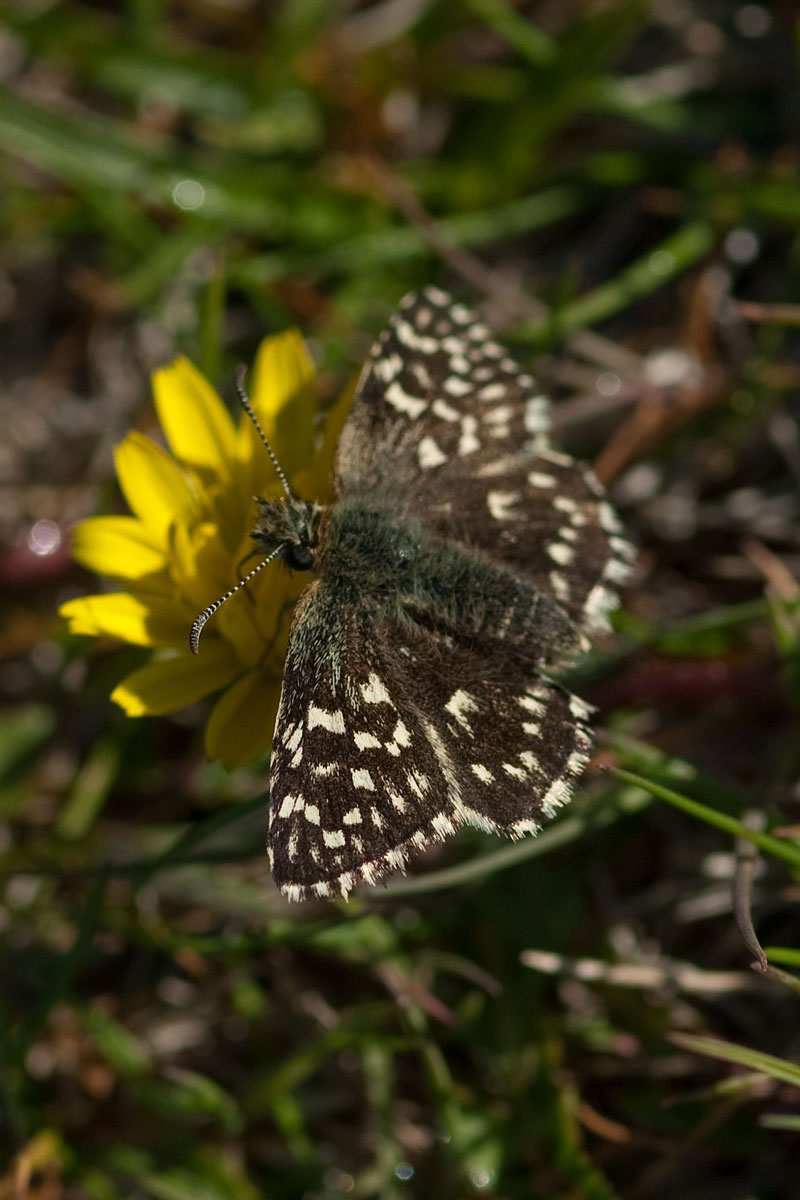
Plenty of White Helleborines in the scrubby woodland, and Common Spotted and Common Fragrant Orchids were abundant. The Pyramida'ls were largely in bud and as it turned out, the Musk Orchids (among others) were yet to get going. Lots of Common Blue butterflies, as well as Small Heath and Large Skippers. A Dingy Skipper posed for us.


We eventually got to Whitecross Green mid afternoon, but worryingly the weather still looked a bit uncertain with plenty of cloud and a cool wind at times. On the way down to the main area, a female Red Deer was a bit of a surpirise-as it slipped back into the wood it flushed a Little Owl.We eventually got down to the mown section of the ride and sat down, not expecting anything to happen. However, during the brief sunny periods something like ten Black Hairstreaks could be seen at the top of the Blackthorn bushes and the small Oak trees. Occasionally one would come lower, but not into camera range. On our return, we bumped into several parties who had been concentrating on another area. This had a few Honeysuckle and Rose flowers for the Hairstreaks, but though they would come down to feed occasionally, it did not happen while we were there, and they were still too far away for the camera anyway.

Sunday, 6 June 2010

Marmora's Warbler

After last years bonanza of lifers, this year has been pretty poor, with only the frustration of Lesser Kestrel dip. We were planning on a major Butterfly and Orchid trip for the weekend as the birding was getting a bit quiet. Plans change suddenly.
The news on Thursday of a Marmora's Warbler on territory in south Wales was exciting, but would it remain until the weekend, and suffering from some sort of virus would I make it. Yes to both, though I was not exactly awake for most of the journey.
We arrived just north of Blaenavon just after nine, to find a completely full car park, but we were able to park on the road. A steady stream of happy birders was a good sign, but by the time we got down to the lower car park, it was a different story. Apparently the warbler does a circuit and can go missing for quite a while. The sight of many so many Whinchat was good to see, as was a number of Tree Pipits and Ravens. Eventually, some movement at Colin's end of the crowd suggested the bird was showing. Apparently it had been singing behind an old wall, and when I arrived was in a stunted Hawthorn. Suddenly it dropped into a small patch of Gorse right in front of me.
It sang for a bit and then flew off. About twenty minutes later it reappeared in a Holly bush to our south before flying off to the hillside again. It remained on view for a while, though distant, then flew down to the roadside briefly, but I could not get the camera on it as it was largely hidden. It then perched on the wall again where it sang for some time.

While all this was happening, Colin had moved the car down to the lower car park saving a long unsteady walk back up the hill, and we departed just after eleven.

 I had decided to call in at RSPB Nags Head in the forest of Dean as it was in an almost direct line home.
A Spotted Flycatcher was the first decent bird, but it took a while to find a Pied Flycatcher, a male bird feeding on the path and perching on the fence. Towards the northern end of the reserve, a number of Wood Warblers were heard singing, and I managed to locate one high in a tree. Alarm calls did not register for a moment, and then a huge female Goshawk drifted over just above the tree.
The heath area was full of Green Tiger Beetles, but not much else was found until we encountered a small crowd watching a pair of Pied Flycatchers feeding young in a nest box.
The light was awful but I did manage to get a few images of the birds flying in and out.

Our final call was at Whitecross Green Wood where we hoped to see Black Hairstreaks. Unfortunately, though it was very warm and humid, it was very overcast. The only butterflies found were large numbers of Common Blues, and the Common Spotted Orchids were only just starting to flower.
The one stunning sight was a fresh Eyed Hawkmoth.

Monday, 31 May 2010

Boring Bank Holiday

Not much of an update, despite having five days off.
Thursday was spent at the Chelsea Flower Show-I have been going for a few years now. Got there very early, so I got a chance to see most of the gardens before the crowds built up. Spent a lot of time in the Pavilion enjoying the plants, especially the orchids (many hardy Lady Slippers from around the world in particular), carnivorous plants, and all the tropical/subtropical things I have a hard time growing. Also nice to see the vegetables by Medwyn Williams-he 'retired' five years ago and I never thought I'd see one of his legendary displays.
Not much in the way of wild life of course-a few tits and the ubiquitous London pigeons. The Ring Necked Parakeets were very vocal and more visible than on previous visits. Chelsea is a guaranteed (but incredibly expensive) way of getting these as a year tick, though for once I'd already seen plenty already.
Got back home incredibly exhausted-about a month back I dropped something on my foot and thought I'd broken a big toe. It was getting better but seven hours on my feet proved too much for it.

Friday was a rest day. Single Large Red Damselfly over my pond was nice-first one for a couple of years.

Saturday morning I went to Amwell. Bill Last was driving off as I arrived so I knew it was a bit quiet. Pair of Little Ring Plovers and a few Redshank flying around. The ducks are starting to moult into eclipse plumage. The cold wind led to drizzle and finally rain, so no dragonflies or butterflies flying. Must have been plenty of Mayflies and things as there were large numbers of Swifts, Sand and House Martins and a few Swallows feeding low over the water. Eventually two Hobby's  appeared-apart from them the only raptor was a female Sparrowhawk crashing through the reeds.

Sunday afternoon was brighter, slightly warmer but with a strong northerly breeze. Decided to walk through Aston End and up the river Beane, mainly to stretch my legs and get a bit of air. Pleasant stroll, even though the toe is still aching. Single Orange Tip, Green Veined White and Peacock, with a few Speckled Woods in sheltered wood glades. Few birds, though one or two Willow Warblers, Lesser Whitethroat, Whitethroat Garden Warblers and Blackcaps still singing.

Today is cloudy and much colder than expected, so I stayed in. Juvenile Goldfinch on the feeders, and a young Blackbird feeding on the ground.

Sunday, 23 May 2010

Hot Weekend

Temperatures have risen considerably this weekend, and as a result butterflies and dragonflies are finally out in good numbers.
I went down to Waterford Heath on Friday, in the hope of finding Grizzled Skipper, even though it is about a month later than I would have usually tried. It took a bit of searching, but I did find two in the southern part. There were good numbers of Peacock, Orange Tip and a couple of Brimstone too. The northern section did not have much at all. A Holly Blue near the car park, and a Large Red Damselfly in the pond.

The plan for Saturday was to stay local, and visit sites in the Chilterns, targeting butterflies and orchids, but we kind of got distracted a bit.
Last week, there were good numbers of Duke of Burgundy at Bison Hill Whipsnade, so we made it our first port of call. The first thing we noticed was that there were huge numbers of Green Hairstreak on every available bush. Working up from the base of the hill, lots of Brown Argus were found, and then several Grizzled Skipper.


Eventually, about half way up the hill I found our first Duke of Burgundy. Unfortunately it was a bit past its best.


PLenty of birds singing-several Lesser Whitethroat, Willow Warbler in particular, and i also had flyby Buzzard and Raven. We were joined by a couple of guys from Northants and spent another half hour searching with them,and not finding any more butterflies, so we decided to leave.
The Chilterns plan went out of the window and we headed off to the Thames. Our aim was to visit the orchid reserve at Hartslock, but poor information meant we could not park any where near it, so instead we went down to the river and hunted for Club Tailed Dragonflies. Despite all our efforts, only one single male was found.  I did see a few Banded Demoiselles on the way back, as well as Small Copper and Common Blue.
Since we were heading south west, the next logical place was Bentley Wood. The eastern clearing was full of Pearl Bordered Fritillaries, as well as a few Small Pearl Bordered. Most were very active in the heat, and it proved impossible to get decent images until Colin located one on a small birch.
At this point we had met up with an old Amwell friend Dick and one of his mates, both of whom are very into butterflies, so I spent a while chatting about our plans this year, and while we were, Jan Hein van Steenis turned up-another Amwell refugee. A huge blur in the grass turned out to be an Oak Eggar Moth which was worth a look. After another long natter, I left them looking for a Marsh Fritillary and headed of to Oakden Wood, aka Botany Bay.
First interesting thing I found was a dragonfly hunting in the woods-turned out to be a Downy Emerald. Past the bridge and following Dick's advice we encountered about twenty Wood Whites. They seemed to be very territorial, and kept gathering on the vetch flowers-up to three per flower head.


Having seen Downy Emerald, we decided to call it a day and not pay a quick visit to Thursley Common.

This morning at Amwell was just as hot as yesterday. Little in the way of exciting birds-a feral Barnacle Goose isn't exactly much to write home about.
Plenty of odontae though. Large numbers of Red Eyed Damselflies are out on the lily pads, and the Hairy Dragonflies are also out in good numbers. Naturally Azure, and to  a lesser extent Common Blue damsels are starting to build up. I also encountered a few Large Reds, and the river held some Banded Demoiselles.
Its been a long hard wait, but finally insects are starting to happen.

Sunday, 16 May 2010

Oriental Pratincole


Saturday morning saw us at Framton Marsh where the Oriental Pratincole has been for a week. The weather was pretty good for once, warm and sunny, but with a bit of a breeze.
PLenty of waders to see on the way to East Hide, with a few summer plumage Curlew Sandpipers among the Dunlin. Lots of Ringed and Little Ringed Plovers, but we missed the Temminck's Stint despite a long search. Only other thing of note was a fine drake Garganey. We arrived to hear that the Pratincole had gone missing, so spent some time in the hide enjoying the birds. A call brought us outside, and for about twenty minutes the Pratincole flew over a grazing marsh, always very distant. However, the views were sufficient to allow identification-the short tail, lack of white trailing edge to the dark underwing etc. Never got a good photo though.
Nice to hear a few Corn Buntings, though the only Bunting to pose was a male Reed.


With little else to do regarding birds, we headed off to a reserve near Peterborough called Upwood Meadows. The ancient ridge and furrow fields are full of Green Winged Orchids, Cowslips and Adders Tongue Fern, along with an abundance of more common species.


While searching, I encountered my first Dragonflies of the year-Four Spotted Chaser and Azure Damsel.
The final visit was Hayley Wood a Cambridge reserve which may be a remnant of the Wild Wood. Large areas are full of Bluebells, and among them are some Early Purple Orchids. Oxlips are also present, though I suspect that what I saw were mainly Cowslip hybrids.


On the old railway line bordering the wood, we watched two male Orange Tips fighting.


This morning at Amwell was pretty quiet, with nothing new present. A pair of Oystercatchers are coming and going as are Egyptian Geese. One or two Hobby's are also present but with few insects to eat its hard to see how they are surviving. The usual Redshanks appear to be displaying and there are still many warblers singing. Had pretty good views of a Cuckoo, but even better was hearing one from the garden first thing.

Friday, 7 May 2010

Bluebells


Since I finish work early on Friday, I decided to visit several woods hoping to get a few images of the Bluebells which are pretty much at their peak.
A recommended site in Graffridge Wood, part of the Knebworth complex was worth a visit and I got a few good images, though wether the composition do justice to the woods is debatable-I was using an old 20mm lens, which is decent optically, but not the best available.


Having got them, I decided to drive around the hamlets east of Stevenage and visit some of the woods that I have not been to for many years. Many of the roadside verges look superb, with Bluebells and various umbellifers such as Cow Parsley in bloom. Unfortunately, my main target, St Johns Wood looked to be pretty poor and I did not stay.
Lots of Pheasant on my drive, along with a few Partridge, Blackbirds and Song Thrush, and at least two juvenile Robins.

Monday, 3 May 2010

Bank Holiday Monday


Typical weather for the Bank Holiday-freezing cold northerly wind, with rain and hail coming down horizontally.
Went down to Amwell and spent most of the morning in the hide, sheltering with everyone else. The Grasshopper Warbler was reeling as I arrived, and the air was full of hirundines. A male Yellow Wagtail was a nice surprise, even more when it was flushed by a Kestrel revealing at least one female (and maybe another in it's talons). In the hide, the pair were seen frequently on the various islands, and appear to be settled.

Three Little Ring Plovers are present now, with at least one Ringed Plover and a single Redshank.

In the woods, I managed to see a Garden Warbler high in a Willow singing. The Blackcaps were of course deep in the bushes and not visible.

A single Orange Tip in a brief spell of sunshine was the only butterfly. As everyone left, a single Hobby was seen hunting over the wood.