Monday, 23 May 2016

Butterflies

After a two week break it was good to get out and about yesterday-last weekend was a dead loss, a cold and hay fever is not the best combination.
I didn't fancy anything long distance, so the Dalmatian Pelican in Cornwall and the Lammergeier that hasn't exactly been pinned down in Dartmoor were non starters. The long staying Great Spotted Cuckoo on Portland was possible (though the Black Billed Cuckoo that was found on North Uist yesterday would have been even better, but not exactly doable in a day on my restricted budget).
So we decided to do the usual spring trip to Hampshire for butterflies and see what turns up. The trip down was ok but the news of the (presumed) Dutch Stilt Sandpiper at Pennington was tempting, but I had left some of my birding kit behind in order to travel light, and having seen a superb breeding bird many years ago there was no real need to divert.
We initially called in at Noar Hill, with rather worrying thick cloud and cool damp conditions and we weren't expecting to see much and so I just took my new 135mm Zeiss lens and the Nikon PN-11 extension tube with a view to get some orchid images. I stuck the 35mm lens in my pocket as well just in case something suitable came up.
We parked, as we have done recently at the west end, and it was a short but slippery muddy walk to the quarry. Not a lot in here so we didn't linger. The Cowslips were still looking pretty good, though a lot were going over (my garden ones peaked well over a month ago) and the few Early Purple Orchids were past their best. A few on the north facing slopes still looked good and there were a few really huge examples. I spent a bit of time trying and failing to get a good image of the abundant Milkwort and in the process disturbed a pair of Duke of Burgundys. Because it was still cool one soon settled down and was very approachable.


 As we climbed the hill, exploring one or two areas new to us the Sun tried to break through and it got a bit warmer.This brought out a few Dingy Skippers and Small Heaths. Common Spotted Orchid rosettes were seen here and there, and the Common Twayblades are starting to look good. We headed down to the south east gate (with some difficulty as the vegetation has grown substantially over the last three or four years). The wood edge here had been cut back a few years ago, to the detriment of the fine start of White Helleborines-my last search failed to locate any. The subsequent regrowth has helped, but the massive increase in nettles and Mercury, coupled with the rather late spring meant that the few plants I could locate were not looking good. Two were in bud, and the remaining four or five spikes appeared to be blind.
One bonus while I was surveying the area was that Colin picked up a Green Hairstreak. This posed for the 135mm/PN-11 combination (the first field test) but the limited focus travel took some getting used to. Might have been a bit better had I took the 100mm macro instead, but I think the results speak for themselves.


We picked up a few more Burgundys on the way back-maybe six all morning, a couple more Dingy Skippers and Small  Heaths and a pair of Green Hairstreaks.
Very little from a birding point of view unfortunately. Turtle Doves have been heard on previous visits-none today. One vocal Garden Warbler, a few Yellowhammers and Whitethroats, and some tits were seen, plus a few Swallows by the cottages.
With the poor showing of the Helleborines it did not seem worth calling in a Chappett's Copse so we went to Bentley Wood. The car parks were full, so we had to park off the road, it had really clouded over and showers were on the way so we didn't say long. The recently cleared area north of the stream was the most productive with lots of Bugle flowering-the southern side seems to be getting more overgrown. Did not take long to find the first of maybe four Pearl Bordered Fritillaries but they were very mobile and only one settled for a brief spell.


Walking north failed to produce the expected Tree Pipits in the usual clearing, so I spent a bit of time on one of the spurges and a rather small moth which I have yet to identify.


The showers arrived shortly after this so we called it a day. Got home to discover it had remained warm and dry all day, and the resident Holly Blue (plus a White) had been in the garden most of the time.

Monday, 9 May 2016

Transit of Mercury

No birding this weekend, due to a family do-it was in a nice part of the New Forest but I was banned from using bins and the camera. Lots of holiday makers, dog walkers etc so I probably wouldn't have seen much anyway.

I had the day off today as a Mercury transit is taking place. I observed the the 2003 event, and recorded it with the 80mm birding scope, an objective filter and imaged with the Coolpix995. Watched the entire event then, which took place from early morning. The next year I was using a TMB115 apo refractor, a Herschel wedge and the Nikon D1x for solar imaging, and saw the entire Venus transit, initially from home and then from Standalone Farm where we held a public viewing event. A few of my images were published in the British Astronomical Association report, and appeared on a few websites.
Using the refractor was a bit of a bind. Initially I had it mounted on a very sturdy photographic tripod and fluid head. This did work, but was prone to vibration and keeping the sun (or any other target) in view with head was very tricky. I eventually picked up an old Vixen Polaris mount which was put on the tripod and was far better, but the tripod was still an issue. The thing is, I already had a much better mount but had no means of connecting the refractor to it.
Before the TMB was purchased, I had obtained an Intes 8" Maksutov Newtonian and a Losmandy G11 mount. Neither item could be considered portable, but it was possible to break the components down and set up outside. Took a bit of time of course but eventually it got too much and everything ended up in storage for quite a long time.
Some time ago, one of the Letchworth and District AS guys, Tom Moss Davies offered to build me a pier so I could have the mount permanently set up outside. A bit of a dilemma then ensued. The refractor works best with a tall pier, the Newtonian needs one rather lower. I settled on a hight that I thought would work, bought a Losmandy-Vixen dovetail adaptor and Tom set to work and we had it all finished a couple of weeks ago.


This is the set up taken today during the transit. Its rather close to the house, but I can stills see most of the sky and virtually all my observing over the last 35 years has been from this spot.
The transit started just after local noon, and I had about three or four hours until the Sun would be hidden by houses. Hazy cloud was really a problem, though there were a few clearer breaks. The high temperature didn't help much either and as a result, the air was very unsteady.
I tried initially getting some video sequences with a 10mm eyepiece (80X) and the iPhone but had a lot of trouble lining everything up and internal reflections seemed to be a problem, so I concentrated on images with the D3s and a 1.7x converter.


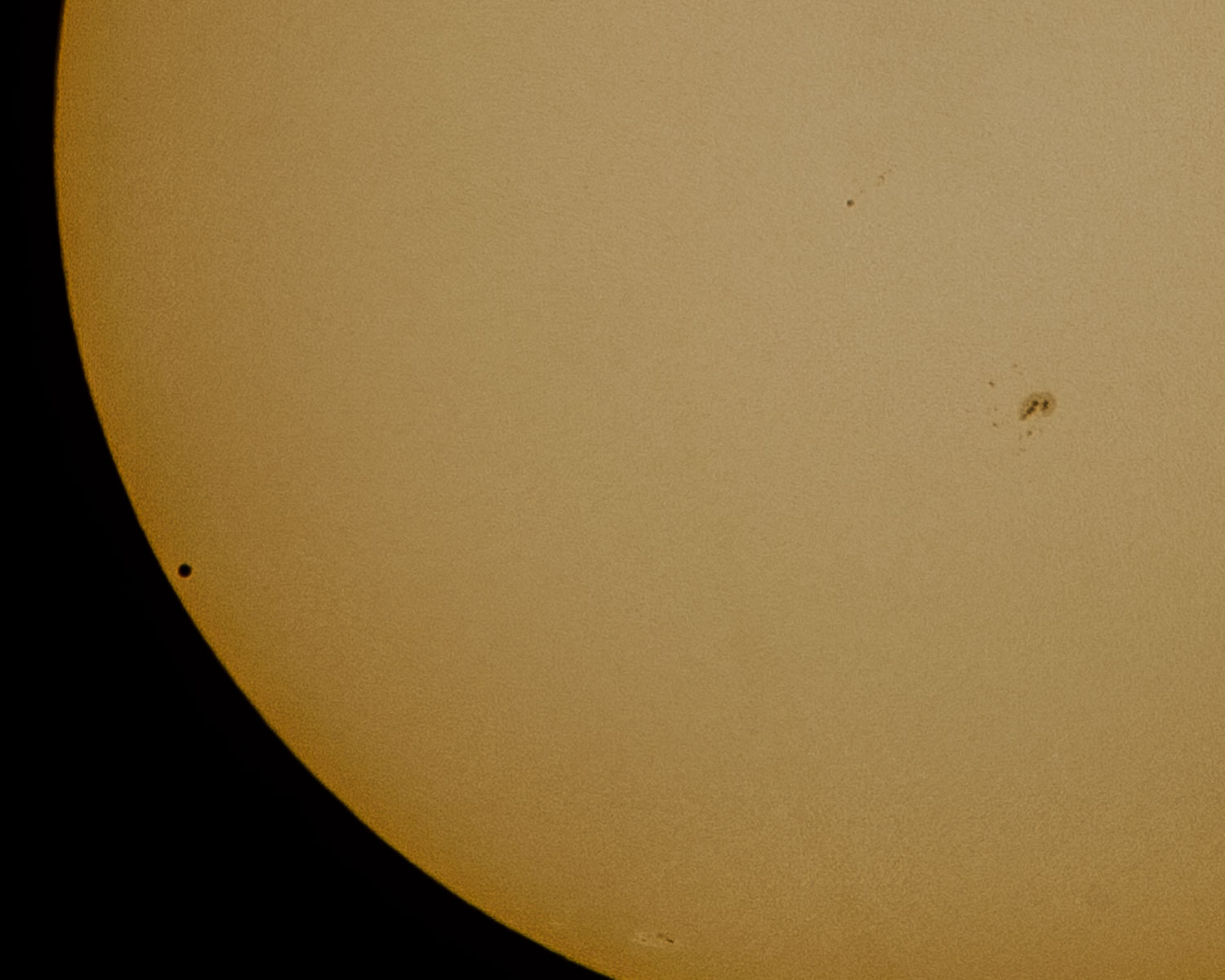
This was soon after first contact and reasonably steady conditions. Its been cropped to show three sunspot groups and the much darker tiny disc of Mercury. BTW north is down and east is left in these images-courtesy of the Herschel wedge.


Cloud was a bit of a problem with the second image, and the air was rather unsteady.


A bit of a close up with Mercury getting closer to the two biggest sunspot groups (both are actually rather small and quiet compared to some we see, but still bigger than Mercury).


The last one I was able to get, and conditions are a lot better. The granulation of the solar 'surface' shows quite well here.
I could have probably got some more images with Mercury near the centre of the solar disc but heat from nearby houses would have been an issue, and thick cloud was starting to build up. The cloud got so bad that the Sun has not been visible since about 4pm-and with about three hours of the transit to go.

Tuesday, 3 May 2016

Images from Sunday


Don't know why I couldn't get them to upload yesterday, but here are some of Sunday's images.

Monday, 2 May 2016

Bank Holiday

Three days off and the weather is a lot better than expected, and I had two good days birding.

Saturday morning was spent at Amwell. The Hollycross dragonfly trail has opened and I was intending to have a walk around. With decent sunshine (when the cool breeze let off) there was a chance of a Large Red Damsel or maybe an early dragonfly. Not to mention butterflies. As it was I never left the viewpoint in the three hours I was there.
William was there with Julie who I hadn't seen for a very long time. A few Swifts were at the south end of the lake, along with a mixed hirundine flock. Three Redshanks and the Oystercatcher pair were present as was  Little Ringed Plover but that flew off towards Tumbling Bay. A bonus was the lingering Dunlin-two were present the previous night. William and Julie went of to search for warblers and I stayed along with Bill and Ade.
As expected we saw a few raptors, mainly Buzzard and Sparrowhawk, with one Red Kite and rather briefly, two Hobbies. The terns seem settled on the gravel banks-luckily the sluice has been fixed and the water levels are looking reasonable now, hence the Dunlin.
We saw a few butterflies, Orange Tip, Small Tortoiseshell and Small White and I picked up a Green Veined White when I left. Despite it appearing rather quiet, I managed to see or hear 61 species-had I gone for a walk I could have added another 5-10.

Sunday looked very good from a weather point of view, but Colin and I decided not to go too far and settled on a trip to Paxton.
We stopped off at the Newnham Ashwell manure heap, finding a minimum of three Yellow Wagtails and at least four singing Corn Buntings. We then stopped at the manure heaps on the Ashwell Eyeworth road. The first Wagtail was Grey, the second White, then several Yellow Wagtails appeared followed by a pair of Pied Wagtails. Again there were a few Corn Buntings present.
When we got to Paxton, it was rather busy and parking was limited. Garden Warbler and Lesser Whitethroat were heard from the car park-neither played ball and eluded our cameras. The first Nightingale did at least show briefly but was too far away and the rest remained invisible in the dense  bushes. Only two Common Terns were seen, and there were no hirundines-perhaps the chilly breeze played a part. The walk round the top of Heron Lake did not produce much apart from a Comma and a rather odd very dark dusky Blue Tit. On the way back I noticed a rather nice, complete solar halo. Colin managed a photo with his 15mm lens, but I could only get a partial on my phone. It attracted interest from a number of others as well.
On the way to Fowler, we called in to the manure heaps again, meeting Aubrey and his mate. Dave unfortunately is out of action again (but in Cyprus so it can't be  too bad). At least two Wheatear were seen on the heap some way off the road along a track, along with several more Yellow Wagtails.
Fowler was rather disappointing in that we failed to see the Turtle Doves. It was a pleasant walk though, with Brimstones and Orange Tips everywhere. As its been many years since I last visited, there have been some changes in particular the large mere in front of the raised hide, but its essentially the same as it was on my first visit 30 years ago.
We ended the day at Therfield Heath and Fox covert. The singing Firecrest that has been here for a while could be heard as soon as we got out of the car. Colin managed to get a few shots, but I didn't. I left him and went onto the heath to check out the Pasque Flowers. It was rather windy and most of them were showing signs of going over-some already had seed heads forming. However I managed a few images with the 135mm Zeiss.
Photos will have to be added later as blogger doesn't seem to want to lead them at the moment.


Sunday, 24 April 2016

Two Ospreys at Amwell (sort of)

I went down to Amwell this morning, but only lasted two hours. Even when the Sun shone it was freezing, with a nasty northerly wind and it never got above 5C. Still I got a few year ticks and a lifer out of it.
Three Arctic Terns were present yesterday, and luckily one of them was still around when I arrived. William and Murray were present and put me on it straight away resting on one of the exposed muddy islands. We later saw it flying around in the company of about half a dozen Common Terns. The Little Ringed Plover was a bit harder and it was only when Tony Hukin arrived to meet up with the Sunday regulars (more year ticks there as I had not seen any of them for ages) and got his scope on it that most of us got to see it. An invisible Reed warbler singing in front of the view point was another tick.
Some time after Tony Wileman arrived William picked up a strange UFO flying over Tumbling Bay to our north west. A big rectangle with a similar sized vertical line in front did not compute until it dawned on me it was a Boeing V22 tilt rotor plane (aka Osprey hence the post title). Never seen one before so an aviation lifer for me. Later on we saw two a long way of to the east apparently heading for Stanstead.
In order to get the circulation going and avoid hypothermia I went for a walk down to Hollycross. Heard a few Sedge and Cetti's Warblers, saw a single Great Spotted Woodpecker and a few Tits. Blackcaps were abundant as were Chiffs, but the calling Cuckoo was very elusive. As far as I know, no-one managed to locate it. I had left Tony making his way to Gladwyn Hide hoping to locate the Lesser Whitethroat that had been reported there recently but not since. Shame I heard one in the brambles near the metal gate at Hollycross. The only other thing seen here was a grazing female Muntjac, which made a change from the goats they used to keep there.
Nothing much different when I got back to the view point. The LRP flew in a bit closer, and a big flock of House Martins had appeared, joining the Swallows and Sand Martins. Had hoped for something like a Common Sandpiper, William wanted a Little Tern, and a few more waders would have been nice. So would a butterfly but I guess they had all froze solid.

May bank holiday next week and the weather looks just as bad.


Tuesday, 19 April 2016

Sunday on Portland

After a very unpleasant Saturday morning with rain and sleet, Sunday was rather good, with wall to wall sunshine and very warm. With a lot happening, Portland was a logical place to go, and many hundreds of birders thought the same.
We stopped off initially at Suckthumb Quarry for an hour where the long staying Hoopoe was still present. Never been there before so parking and access was a bit uncertain. As it turned out we ended up about as far away as was possible, but it got us a few good birds. It was evident that birds were coming in all the time, with a constant northward movement of hirundines and small jobs. Warblers were everywhere, mainly Chiffchaff Blackcap and Willow with a few Whitethroat around. A bonus was the reeling Grasshopper Warbler found shortly after a local birder pointed us in the direction of the Hoopoe. This proved to be easy to see, feeding on a short piece of turf on the quarry track, but stayed well away from the attendant photographers.


On the way back to the car we found a female Redstart in the horse paddocks but a passerby on the adjacent footpath flushed it so i never got any good images.
The bill was very busy, being full of day trippers. Being calm and sunny the sea was rather quiet with only the resident Razorbills, Guillemots and Shags on view. There were several singing Rock Pipits of course.


We made our way to the observatory, checking the Little Owl in the quarry. On the hill side we could see a big crowd waiting for the Bluethroat. We were told it was very elusive and only a few had seen it all morning so we headed down to the east cliff and the Western Subalpine Warbler.
This was a difficult bird, staying low in the alexanders and it was rare t see more than a fraction of the bird. Got a superb scope view of t's head from ten yards before I concentrated on the camera. The Chiffs and Willows feeding with it were a lot more confiding but over the course of half an hour we did get a few brief good views.


We called in to the Fleet for a few minutes but the tide was out, there were hardly any birds on view but I did get to see three rather distant Sandwich Terns far out by the fish farm pens.
I was hoping to see the wintering Pallas's Warbler at Portisham-it had been seen earlier in the day. We met several groups birders there but none had seen the bird and we didn't either. Chiffchaffs and Backcaps were singing, as were tits and Chaffinches, but there was neither sight nor sound of the Pallas's though we all covered a large section of the footpath. At this time of year i would have expected to hear it sing-I did surreptitiously play a recording a couple of times but got no response.
Despite the warm day, our one and only butterfly-a Tortoiseshell was seen here.

Saturday, 16 April 2016

Ring Ousel Hunt

Just got back from a drive around the Therfield area. Deadmans Hill and Coombe Road have been good for passage Ring Ousels with several reported in recent days.
Mike Illet had reported at least two were still present in Coombe Road earlier this morning so it looked promising. Of course as soon as I left the house the rain started and it proved to be rather unpleasant out, maximum temperature was 3C and the rain was sleety at times. Lots of standing water and slippery mud added to the fun drive.
The first valley west of the farm seemed to have a few birds milling around, Song and Mistle Thrushes were singing and there were a lot of pigeons and corvids were perched up in the trees at the back. I noticed a 'Blackbird' fly into one of the hawthorns but never got a good view of it and not long after two flew out and towards the horse fields. The light was awful and I couldn't be sure what they were-very frustrating.
I then headed down the road to the more open valley, and about ten minutes later Simon Knott appeared, on his way to an organised walk on Therfield Heath. In view of the weather I don't think its going to be much fun. We didn't see any thrushes at all so he went of to the walk and I carried on.
Stopped off briefly at Deadmans Hill-one Red Legged Partridge is all I got, then driving up towards Sandon a male Ring Ousel flew across the road. Being a busy road there was no way I could stop and get photos, assuming it hadn't flown on.
On my way home I had a very weird experience. In one of the hamlets I could see ahead of me several tiny round blobs moving slowly around in the road. For a moment I assumed they were bumblebees grounded by the weather but they turned out to be Field Voles.